The best wholesale marketplaces for your CPG brand are the ones that reach buyers you can serve profitably. Start with the buyer you need, the pack you can ship, and the cash you can commit. A platform with a familiar name is still the wrong channel if every order creates an operating problem.
This guide is for brands selling packaged goods, not retailers looking for wholesale inventory. It covers six routes available to evaluate in North America, with US and Canadian distinctions where verified. Platform sources were checked September 30, 2026. Confirm your specific country, product, and fulfillment eligibility before investing in onboarding.
Choose wholesale marketplaces by the buyer you need
Choose your route before choosing your platform. A store buyer ordering cases, a category manager reviewing submissions, and a shopper purchasing one pack represent different sales processes. Each needs a different offer, fulfillment plan, and measure of success. The first decision is which relationship your business needs next.
Use this short decision tree to narrow the field.
| Your immediate need | First route to evaluate | Readiness question |
|---|---|---|
| More retailers placing wholesale orders | Wholesale ordering marketplace | Can you ship small opening orders profitably? |
| Consideration by retail buying teams | Buyer discovery and submissions | Can you support the account if selected? |
| Access to a distributor's customer network | Distributor marketplace program | Can you meet its supplier fulfillment requirements? |
| More individual shoppers | Consumer marketplace | Can your consumer pack fund fulfillment and acquisition? |
| Placement with a specific online retailer | Curated retailer partnership | Does your assortment fit its buying criteria? |
| Sales through another merchant's online store | Partner commerce | Can you fulfill that partner's customer orders reliably? |
Pick the row that describes your current bottleneck. If customers already want the product but small orders lose money, another discovery surface will not fix the pack economics. If the warehouse is ready but the intended buyer never encounters your brand, distribution of your commercial offer becomes the priority.
A marketplace listing, a retail submission, and a distributor program are different routes to revenue. Compare each against the job you need done before comparing fees or audience size.
Keep existing accounts in the plan. New-channel work needs a time budget so it does not consume the hours required to maintain reorders from stores that already know the product.
Separate six routes that solve different problems
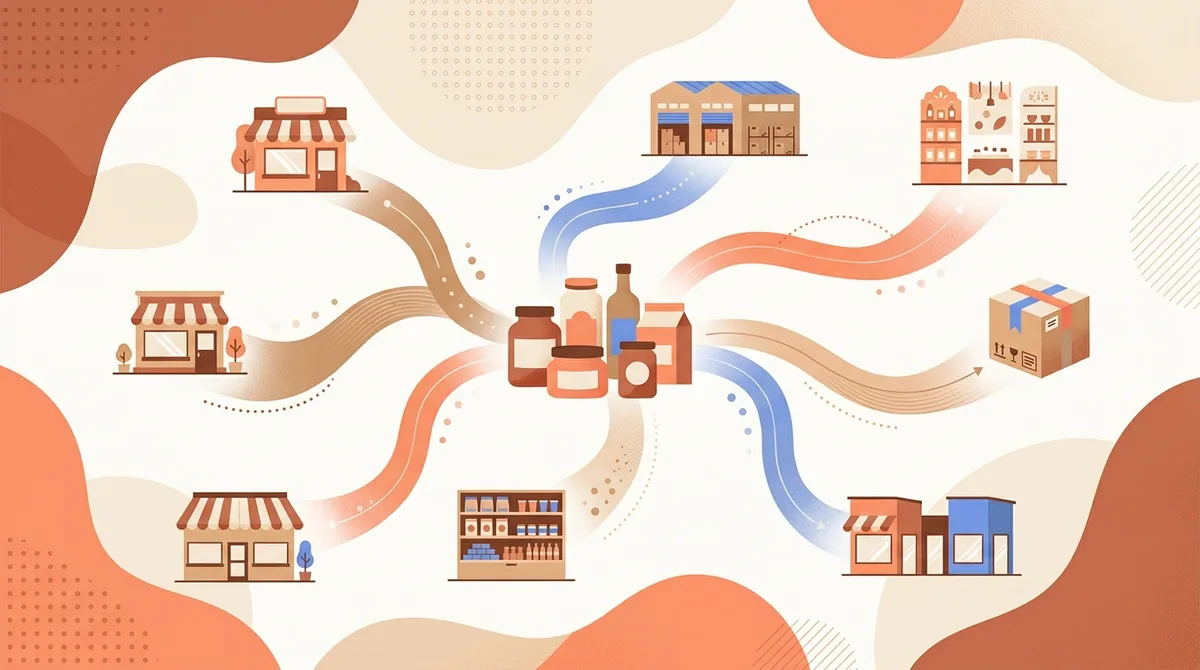
The six routes differ mainly in who buys, who accepts your brand, and who fulfills the order. That distinction determines the work you inherit. Build your shortlist from those responsibilities rather than treating every website with products on it as an interchangeable marketplace.
Wholesale ordering means a business purchases your products for its own assortment. Your offer needs a wholesale price, clear case configuration, and a manageable opening order. Measure account contribution and repeat ordering.
Buyer discovery puts your product in front of people evaluating an assortment. A profile view or sample request is a step in a sourcing process. Track the next commercial milestone instead of treating attention as a purchase order.
Distributor marketplaces can expose your assortment to an established customer network while requiring you to fulfill orders. Marketplace availability alone does not establish warehouse stocking or a place on the distributor's regular truck route.
Consumer marketplaces require a retail offer. Pack size, parcel cost, content, customer service, and returns matter at the individual-order level. Wholesale case economics do not automatically survive that change.
Curated retailers select products for their own offering. Your first task is winning assortment consideration. Commercial terms and supply arrangements then determine whether the account works.
Partner commerce lets another merchant sell your product through its store. Establish the order handoff, inventory responsibility, shipping promise, and return process before launching a partnership.
Retail media sits alongside these routes. Instacart's advertising documentation describes sponsored products and other ad formats across its shopping experience. Treat advertising as a demand investment with its own availability and measurement requirements, not as proof that a retailer has agreed to stock your product.
Compare the main North American options
Use these platforms as a starting shortlist, then verify the actual program you intend to join. The notes below describe channel mechanics checked in September 2026, not a ranking of likely revenue. Country coverage and seller eligibility are separate questions, and private account terms need their own review.
Faire and Airgoods for wholesale orders
Faire's brand page describes a wholesale marketplace spanning categories including food, beauty, and home goods, with seller applications and availability in the US and Canada. Brands accept retailer orders and arrange fulfillment. Start here when independent retail accounts fit your assortment and case sizes.
Airgoods' seller page focuses on specialty food and beverage wholesale. For a US food launch, evaluate the buyer fit and the delivered cost of your opening assortment. Confirm eligibility directly before planning a Canadian or Mexican operation. Our Faire versus Airgoods comparison separates the commercial details that deserve a closer look.
RangeMe for buyer discovery
RangeMe connects suppliers with retail and foodservice buyers through product discovery and submission opportunities. Choose it for a defined sourcing objective. Check the geography and criteria of the particular opportunity; a platform profile does not guarantee an invitation, listing, or order.
Treat samples, responses, and meetings as separate stages. The Faire versus RangeMe guide explains why wholesale orders and sourcing progress need different scorecards.
Mable programs for distributor customers
Mable's program guide distinguishes UNFI Endless Aisle, McLane Emerging Brands, and US Foods Direct. These serve different customer networks. UNFI describes Endless Aisle as a route for suppliers to dropship products directly to retailers.
Evaluate the specific US program's onboarding, fees, service requirements, and assortment fit. Do not budget on the assumption that a distributor receives and stores your inventory. The Mable distributor marketplace guide maps the responsibilities in more detail.
Amazon, Walmart, and TikTok Shop for shoppers
Amazon's US grocery guide distinguishes product eligibility from fulfillment eligibility. Selling a grocery item does not automatically make it suitable for Fulfillment by Amazon. Model the consumer pack and its fulfillment route together.
Walmart Marketplace provides a seller route to online shoppers, with application and fulfillment decisions to resolve. Evaluate the target country's marketplace separately. Approval to sell through a marketplace is not an agreement for placement on physical store shelves.
TikTok Shop's US shelf-stable food requirements include product restrictions and documentation rules. Establish eligibility before investing in creator content. A product that demonstrates well still needs a compliant listing and a dependable shipping operation.
Curated online retailers for assortment placement
Thrive Market's brand partnership page invites brands to submit information for consideration. Approach this route with a specific assortment pitch and a clear supply proposal. Get the actual commercial and fulfillment terms before forecasting an account's contribution; a public application page does not establish them.
Shopify Collective for partner commerce
Shopify Collective's supplier guidance describes selling through other Shopify retailers, with the supplier fulfilling orders directly to the customer. Its connection requirements include stores being in the same country and using the same currency. The supported list includes the US and Canada.
A partner's storefront is another merchandising surface, but each order still needs an owner. Agree how stock changes, late dispatches, and customer problems will be handled.
For your existing Faire and Shopify wholesale accounts, assign the same clarity of ownership. Opener analyzes reorder patterns, manages buyer follow-up, and works to reactivate dormant accounts. Those are account-management activities, separate from choosing and launching a new sales channel.
Opener manages Faire and Shopify account follow-up and reorder signals while your team builds its next channel.
Book a DemoLet product constraints narrow your shortlist
Product constraints should eliminate unsuitable operating models before you spend time building listings. Work from the packed shipment, usable shelf life, storage requirements, and likely order size. A channel that fits the category can still fail your particular SKU. Test the physical order before forecasting the digital sale.
These are hypothetical product situations, not brand results or platform acceptance claims.
| Product situation | Test before applying | Decision it informs |
|---|---|---|
| Shelf-stable snack | Small case margin and remaining shelf life after transit | Whether an opening wholesale order is viable |
| Heavy beverage | Packed weight, breakage protection, and distant-zone freight | Whether regional wholesale or a consumer multipack is workable |
| Beauty consumable | Leak protection, product claims, and repeat-use purchase cadence | Whether the assortment and replenishment model fit |
| Temperature-controlled food | Documented category eligibility and validated delivery conditions | Whether to proceed at all with the proposed route |
For each candidate, pack a representative order and price its shipment. Include materials and handling. The warehouse's ability to ship a master carton does not establish its ability to fulfill mixed retail orders without extra labor.
Prepare a single accurate product record, then adapt the commercial offer. Unit identifiers, ingredients, dimensions, and storage instructions should stay consistent. Wholesale cases, consumer bundles, images, and buyer-facing copy should match the channel's actual buying context.
Keep US, Canadian, and Mexican requirements distinct
Choose the destination country explicitly in every channel plan. The presence of a platform in one market does not establish seller eligibility in another, and seller eligibility does not settle the requirements for a particular product. Treat cross-border expansion as a separate operating decision with its own costs and responsibilities.
Faire's US and Canadian presence and Collective's supported-country list are useful starting points. They do not establish that every SKU can move across the border or that a US operating guide applies unchanged to a Canadian account. Collective's same-country connection rule is a concrete example of why regional assumptions fail.
For Mexico, obtain current program-specific eligibility and product requirements before building the launch. This shortlist makes no blanket claim of Mexican access. If those facts are unresolved, begin with a supported domestic route rather than committing inventory to an unverified expansion.
Record the selling entity, destination market, settlement currency, ship-from location, and party responsible for product and import requirements. Leave a candidate out of the active test until those responsibilities are resolved.
Budget one channel test before adding the next
Budget the test around contribution, cash timing, and service capacity. Define the assortment, spending limit, review date, and person responsible before launching. A useful experiment produces a decision you can act on. A collection of open marketplace accounts produces more dashboards and more inventory promises to maintain.
Use this scorecard for each shortlisted channel.
| Question | Evidence to collect | Continue when |
|---|---|---|
| Does the buyer fit? | Qualified orders or specific sourcing progress | The response supports your intended customer segment |
| Does the order contribute? | Revenue less product, channel, fulfillment, and service costs | Contribution meets the threshold you set before launch |
| Can cash support it? | Actual payout timing and inventory commitments | Replenishment does not outrun available working capital |
| Can you deliver consistently? | Dispatch, cancellation, damage, and support records | Service stays within the promises you made |
| Is there a repeatable next step? | Reorders or documented next sourcing milestones | Progress extends beyond initial launch attention |
For example, a hypothetical $240 order with $110 product cost, $42 channel costs, $28 freight, $10 packing, and $15 allocated service cost leaves $35 before acquisition costs and overhead. A $25 sample shipment attributed to that opening order reduces the result to $10. These are illustrative inputs, not any platform's fee schedule.
Use actual terms in your own calculation. Track opening orders separately from reorders, and avoid counting future repeat purchases as money already earned. For buyer discovery, budget the subscription and sample effort against specific sourcing milestones rather than comparing it directly with checkout conversion.
Do not average an unprofitable opening offer together with hoped-for reorders. Keep acquisition cost visible until repeat purchases actually occur, and track the time your team spends servicing the account.
Pause expansion when the offer needs repair. Fix the pack, shipping promise, or commercial terms before adding another platform that multiplies the same problem.
Choose your next operating guide
Choose one route and take the next concrete step. For a food wholesale launch, the Airgoods selling guide covers catalog preparation, order costs, and reorders. Use it once the buyer and fulfillment model fit your business.
For buyer discovery, assess whether RangeMe is worth the investment against the specific sourcing work you intend to do. Do not upgrade simply to make a profile feel more complete.
For consumer commerce, start your Amazon food selling plan with the product and fulfillment checks. Build one workable offer, measure the complete order, and expand after the operating evidence supports it.
Opener gives Faire and Shopify wholesale accounts ongoing attention, from reorder follow-up to dormant-account reactivation.
Book a Demo