
A CPG marketing plan should tell a small team what to do, what to ignore, and how each activity produces trial, repeat purchase, or stronger retail accounts. It does not need a large department. It needs clear decisions, a short list of reusable assets, and a weekly operating rhythm that turns strategy into work.
That distinction matters when one person suddenly owns go-to-market strategy, naming, packaging, positioning, journey mapping, and segmentation. A recent practitioner discussion described exactly that situation after a CPG category team was eliminated. The problem was not a lack of possible tactics. It was too many responsibilities with no operating system.
This playbook gives you that system. Build it once, run it every week, and improve it as real sales data comes in.
What a CPG marketing plan needs to contain
A useful CPG marketing plan connects five things: a commercial goal, a specific shopper and buying occasion, a defensible product promise, a focused channel plan, and a scorecard. If one is missing, the team stays busy but cannot tell whether the work is creating demand or helping product move through retail.
Keep the plan to one page. The supporting briefs and calendars can live elsewhere, but the decisions must fit in a format the founder, a freelancer, and a retail account owner can all understand in five minutes.
Your one-page plan should answer:
- What commercial result matters during the next 90 days?
- Who is the priority shopper, and in what moment do they buy?
- Why should they choose this product instead of the current alternative?
- Where can the brand reach them efficiently?
- What evidence will show that the plan is working?
This is more disciplined than a list of channels. "Run paid social, hire creators, send email, and book demos" is an activity list. "Increase weekly velocity in 40 priority stores by creating trial among afternoon snack shoppers" is a plan.
Start with one commercial job for the next 90 days. Launch, velocity, repeat purchase, and retail expansion require different messages, channels, and metrics. A small team cannot optimize all four at once.
Build the strategy around five decisions
The best lean product marketing playbook is a sequence of decisions. Each decision narrows the work that follows. That is the advantage a small team has over a large one: fewer handoffs, faster feedback, and no need to win consensus from six departments.
Decision 1, Choose the commercial job
Name the result before discussing creative. A new product may need qualified trial. An established SKU may need better repeat. A brand entering a new retailer may need concentrated demand around a small group of doors. An account with falling reorders may need better retailer support rather than more consumer impressions.
Write the objective as a change in observable behavior. Good objectives sound like this:
- Increase first purchase in the stores that launched this quarter
- Raise repeat orders from active independent retailers
- Generate enough local demand to support a regional buyer review
- Move attention from a slow SKU to a format with stronger repeat
Avoid "grow awareness" unless you can define whose awareness, where it matters, and what action should follow.
Decision 2, Define the shopper and the occasion
Demographics alone do not produce useful messaging. "Health-conscious women aged 25 to 44" is too broad. A buying occasion gives the team something concrete: a commuter replacing breakfast, a parent packing a school-safe snack, or a host looking for a premium alcohol-free option.
Document the shopper's trigger, current alternative, objection, and proof requirement. Those four fields shape packaging copy, creator briefs, sales materials, demos, and retailer pitches. If you have not validated the occasion, start with the pre-launch viability questions before spending on production.
Decision 3, Make one product promise
Your product promise is the clearest credible reason to switch. It should survive three formats: a five-word shelf message, a one-sentence product description, and a thirty-second founder explanation.
Build a simple message hierarchy:
- Promise explains the outcome or experience
- Reason to believe provides proof
- Differentiator names what is meaningfully different
- Objection answer removes the biggest reason not to buy
- Use occasion shows where the product fits into real life
Do not ask every channel to invent its own version. The Instagram post, sell sheet, product page, and buyer conversation should sound like the same brand. If the foundation is still moving, settle the positioning and naming decisions before scaling content production.

Once these decisions are fixed, execution gets faster. A freelancer can produce within constraints. A founder can approve work without reopening strategy. A sales partner can use the same proof points with every account.
Opener gives every retail account its own AI rep, so your team can stay focused on the product and the plan.
Book a DemoDecision 4, Choose the smallest viable channel mix
Small teams lose when they copy the channel mix of brands with national distribution and specialist teams. Choose channels based on where the product is available, how the shopper discovers the category, and how quickly you can learn.
Use three filters for every proposed channel:
- Distribution fit asks whether people can buy the product where the activity runs
- Occasion fit asks whether the channel reaches shoppers near the buying moment
- Learning speed asks whether the team can see a meaningful signal within 90 days
A regionally distributed beverage brand gets more from geo-focused creators, retailer-specific promotions, demos, and email than from broad national reach. A DTC-led product may prioritize search, creator content, sampling, and lifecycle email. The right mix depends on the commercial job, not on which platform is fashionable.
Pick one primary demand channel, one owned follow-up channel, and one retail activation method. Add another only after the current mix produces a repeatable signal. If email is part of the system, automate the basic CPG email and SMS journeys so the team is not rebuilding every send.
Decision 5, Define the scorecard before launch
Measurement should reflect the job you selected. Circana defines CPG marketing around driving trial, repeat, and brand equity. A small team rarely needs a complex attribution model to know which of those it is trying to improve.
Use a scorecard with three levels:
- Commercial outcome such as revenue, velocity, reorder rate, or active accounts
- Behavior signal such as sample conversion, coupon redemption, email repeat purchase, or buyer response
- Execution health such as store coverage, content shipped, demos completed, or campaigns launched on time
Execution metrics diagnose the system. They are not the goal. Publishing twelve posts means nothing if qualified traffic, store-level demand, and sales remain flat.
Do not let platform metrics become the strategy. Reach, views, and clicks are useful only when they connect to product availability, shopper action, and commercial results.
Build the playbook in 30 days
You can build the first version of a CPG product marketing playbook in four weeks. Do not wait for perfect research. Use the evidence you have, write down the assumptions, and create a cadence for replacing assumptions with real market feedback.
Week 1, Gather the truth
Interview the founder, the person closest to customers, and the person closest to retail accounts. Review customer messages, product reviews, retailer feedback, search terms, sales by SKU, and reorder patterns. Pull out repeated language, buying occasions, objections, and accounts where the product already works.
Finish the week with the one-page plan. Choose one objective, one shopper occasion, one product promise, and one priority market.
Week 2, Create the reusable core
Build the message hierarchy, a short FAQ, three proof points, a product description, and a basic visual brief. Turn those inputs into the assets every channel needs: product-page copy, retailer sell-sheet language, creator talking points, demo scripts, and email copy.
This is the right moment to use outside help for bounded craft. A packaging designer can improve hierarchy. A copywriter can sharpen language. A media buyer can structure a test. Keep strategic ownership inside the company and use specialists for defined outputs. If you need broader help, compare the real scope before choosing a CPG marketing agency.
Week 3, Connect marketing to the shelf
Map activity to the places where the product can actually sell. Mark launch dates, retailer promotions, demo windows, inventory risks, and regional availability. Give every campaign a list of stores, accounts, or online destinations where demand should land.
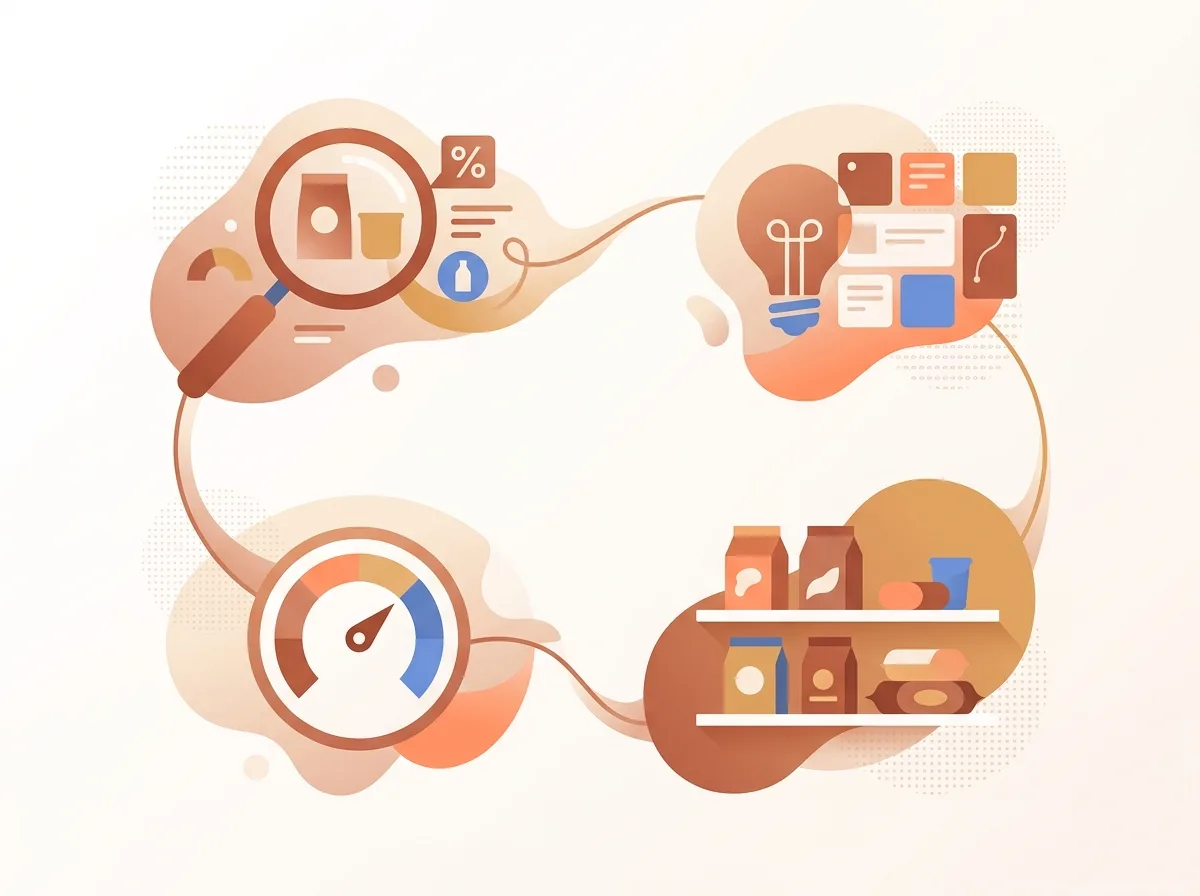
For retail launches, the marketing calendar and account calendar should be the same calendar. A creator post that runs while priority stores are out of stock wastes the attention. A promotion the sales side learns about after it starts wastes the retailer relationship. This is why shopper marketing and product marketing cannot live in separate documents. Use a retailer-specific shopper marketing playbook when an account needs its own activation plan.
Week 4, Install the operating rhythm
Set a weekly 45-minute review. Look at the same scorecard every time. Decide what to continue, what to change, and what to stop. Record the decision and the evidence behind it.
The meeting should answer four questions:
- What moved in the commercial outcome?
- Which shopper or buyer behavior changed first?
- What execution problem affected the result?
- What single test runs next week?
That rhythm is the playbook. The document creates alignment once. The review creates learning every week.
Split the work without building a department
A lean CPG marketing team needs clear ownership, not many people. The founder owns positioning and commercial priorities. Specialists own bounded craft. Systems own recurring coordination and reporting. No agency can replace the first job, and the founder should not keep doing all three.
BCG found that 68% of CPG marketing leaders saw organizational silos and poor collaboration as their biggest hurdle. Small brands can avoid that problem by connecting marketing, sales, and retail execution from the start.
Use this ownership model:
| Work | Best owner | Required output |
|---|---|---|
| Positioning and priorities | Founder or brand lead | One-page plan and decision log |
| Design, copy, media, and research | Specialist or fractional operator | Defined project with acceptance criteria |
| Retail account follow-up | Account owner or account-management system | Current next step for every active account |
| Reporting and coordination | Shared system | Weekly scorecard and calendar |
Wholesale account execution deserves its own owner. Product marketing creates the promise and the activation plan. Account management makes sure buyers hear about new products and promotions, watches reorder behavior, and catches accounts that start to slow.
Opener fits that execution layer. It is a wholesale account management platform for CPG brands growing through Faire and Shopify. It gives every account its own AI rep, works from order and buyer-conversation history, and helps manage active accounts and revive dormant ones. It is commission-based, with no retainer or setup fee. Your team still owns positioning, and Opener is not designed for high-volume cold prospecting.
That boundary matters. Automate repeatable account work. Keep product judgment, brand choices, and the most important buyer relationships human.
See how Opener works your existing wholesale book and helps quiet accounts reorder.
Book a DemoKnow when the plan is working
The plan is working when the team can explain why a result changed and what it will do next. You should see fewer disconnected campaigns, faster asset production, cleaner retail launches, and a clear link between marketing activity and commercial outcomes.
Review the full plan every quarter. Keep the product promise if it still converts. Change the channel mix when distribution changes. Replace assumptions when customer, retailer, and reorder data prove them wrong. The point is not to preserve the document. The point is to make better decisions with less overhead.
You do not need an expensive team to run disciplined CPG product marketing. You need one commercial objective, one shared message, a channel mix that matches distribution, and an operating rhythm that keeps strategy connected to the shelf.
Opener manages active accounts and revives the ones that have gone quiet, on a commission-only model.
Book a Demo