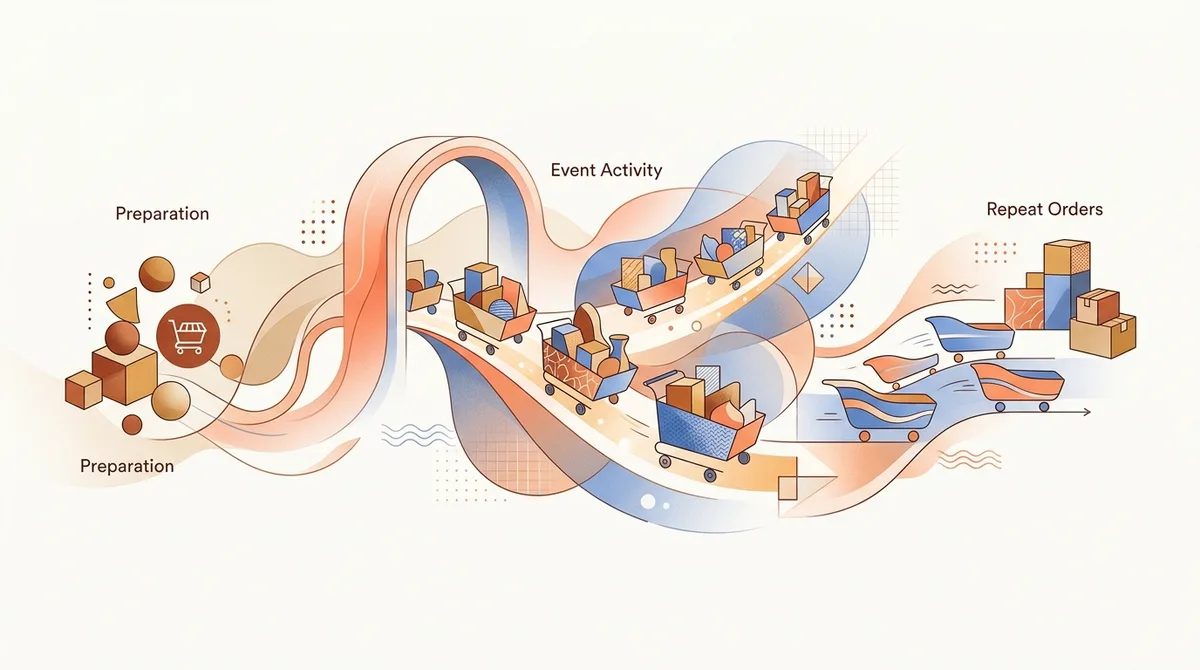
Faire Market ROI is created before the event and proven after it. The brands with a useful campaign do not wait for Market traffic, post the deepest discount, and count event-week revenue. They earn a place on retailer shortlists, protect contribution, fulfill cleanly, and turn opening orders into full-price reorders.
Treat Market as a six-week operating window with one cohort and one scorecard. Two weeks of preparation, one event window, and at least three weeks of account kickoff will tell you far more than the sales total on the final day.
How Faire Market works for brands
Faire Market is a biannual online buying event. Participating brands create Market promotions, and Faire may match eligible offers under the current event rules. Retailers browse event specials, build carts, and place opening orders or reorders during the event window.
The exact dates, matching structure, promotion restrictions, and stacking rules can change. Check the current Faire Market brand guide before building the offer. Do not reuse the terms from a previous Market without verifying them.
The event creates concentrated retailer attention. It also creates concentrated competition and discounting. Your job is to arrive with demand, a clear assortment, enough inventory, and an economic limit.
Market is not the acquisition strategy. It is the conversion window inside a larger campaign. The target list, preview, merchandising, and reminder cadence create the opportunity. The post-order work determines whether the discounted account becomes valuable.
Define Faire Market ROI before the offer
Choose one primary objective. Common options include:
- Acquire new best-fit retailers
- Reactivate dormant accounts
- Increase reorder size from active accounts
- Launch a new product into existing stores
- Move a seasonal assortment before its buying window closes
Do not combine all five into one campaign. Each objective needs a different audience, message, offer, and success metric.
Then define ROI as contribution, not gross merchandise value.
Market cohort contribution = discounted order subtotal minus Faire fees, product cost, fulfillment, brand-funded freight, advertising, replacements, and account labor
Follow that contribution at 30, 90, 180, and 365 days. The Faire unit economics guide includes the current fee stack and a complete opening-order model.

Build the pre-Market baseline
Record the previous eight to twelve weeks for the audience and products you plan to feature. Capture opening orders, returning orders, average order value, product mix, contribution, first-to-second-order rate, and median reorder timing.
Separate four account groups:
- Prospects with a known fit but no order
- Existing accounts approaching a likely reorder date
- Dormant accounts with a relevant reason to return
- Low-fit or low-margin accounts you will not target
The fourth group matters. Market urgency can push a team to send every offer to every buyer. That produces shallow messaging and attracts orders you may not want.
Use the Faire success diagnostic to check whether your underlying storefront and economics are ready before the event adds more traffic.
Refresh the storefront two weeks early
Retailers often plan before Market opens. Faire's own retailer preparation guide says buyers research brands and set shortlists in advance. Market is frequently where they confirm a decision already taking shape.
Two weeks before the event:
- Put bestsellers, newness, and the featured assortment on the first screen
- Confirm titles, categories, attributes, images, case packs, and product details
- Remove stale seasonal collections
- Check inventory and realistic lead times
- Make the opening order easy to build
- Verify wholesale and suggested retail pricing consistency
- Test every external link and Faire Direct link you plan to use
Use the Faire SEO storefront checklist for the detailed audit. The goal is not to rewrite the whole catalog. It is to remove the friction facing the specific retailer you plan to reach.
Opener analyzes your Faire orders and buyer conversations to surface reorder patterns, dormant accounts, and SKU-level performance.
Book a DemoSet the offer from margin backward
Start with the contribution you can afford to exchange for acquisition or reactivation. Then build the smallest offer likely to change behavior.
For a new account, calculate the discounted opening-order contribution and expected first-year contribution using observed reorder behavior. For an active account, compare the offer cost with the incremental basket or earlier reorder it should create. For a dormant account, compare the reacquisition cost with the value of a credible return.
Consider more than the percentage discount. A focused starter assortment, a threshold offer, a product-specific incentive, or shipping support may protect margin better. Check current Market rules before assuming how promotions stack or qualify for matching.
Do not use expected future reorders to justify a loss today unless your cohort history supports the assumption. “They will reorder” is not a model.
Prime the right retailers before Market
Send a preview before the event noise begins. The message should explain why the assortment fits that retailer, what is new or timely, and when the offer becomes available.
Use different messages by segment:
Prospects. Lead with retailer fit and a low-risk starting assortment. Give them a reason to save the brand or build a cart before the event.
Active accounts. Reference the previous assortment and likely stock position. Recommend a replenishment or one relevant addition.
Dormant accounts. Name the change. New SKU. New format. New price point. Better proof. A generic “we miss you” message gives the buyer no commercial reason to return.
Top accounts. Give them advance context and protect the relationship. Do not let a broad blast become the first time a valuable buyer hears about the offer.
Keep the cadence controlled. One preview and one timely reminder usually beat a stream of near-identical messages. Respect consent and channel preferences outside Faire.
Do not wait until the first morning of Market to announce the offer. Retailers already have full inboxes and partially built carts. Earn consideration while they are still deciding where the budget will go.
Protect inventory and fulfillment during the event
A successful sales spike can damage the account base if inventory or lead times fail. Reserve inventory for the promoted assortment. Set a clear owner for stock updates, order acceptance, retailer questions, and warehouse coordination.
Prepare three scenarios:
- Base case at expected order volume
- High case that uses overtime or a secondary packing plan
- Stop case where you remove products or end outreach before service breaks
Publish lead times you can meet. Update inventory quickly. Avoid accepting orders you already know will be late or incomplete. Search performance and retailer trust are both shaped by the service pattern that follows the sale.
Track damaged and missing items by SKU. A fragile hero product may produce revenue while creating enough replacements and account friction to weaken the event cohort.
Use Promoted Listings as a separate experiment
Paid listings can add visibility during Market, but the event already changes traffic, urgency, and discount behavior. Create a separate campaign budget and tag its accounts.
If acquisition is the goal, use the new-customer audience. Record the organic baseline and keep paid acquisition cost separate from the brand-funded offer. The Faire Promoted Listings testing plan explains how to distinguish attributed revenue from incremental contribution.
Do not add spend only because order volume is rising. The event itself may be creating the lift. Scale paid listings when the paid cohort clears its own economic threshold.

Run the first 30 days after Faire Market
Start account work as soon as the order arrives.
Before shipment. Confirm any material substitution or timing issue. Pack accurately. Include only retailer-useful material.
After delivery. Confirm the order landed cleanly. Share a small merchandising kit with product images, key selling points, and display guidance.
During the launch window. Ask where the product is placed and whether staff need anything to explain it. Do not demand sales data the retailer cannot easily provide.
Before likely stockout. Recommend a reorder based on the opening units, product type, and any store feedback. Make the next order easy to build.
The Faire reorder and retention guide provides the full 30-day kickoff and account segments.
Measure Faire Market over one year
Build one cohort for each event. Report new and returning accounts separately.
| Metric | Event window | 90 days | 180 days | 365 days |
|---|---|---|---|---|
| New accounts | ||||
| Returning accounts | ||||
| Gross merchandise value | ||||
| Brand-funded discount | ||||
| Ad spend | ||||
| Contribution after acquisition | ||||
| First-to-second-order rate | ||||
| Full-price reorder revenue |
These empty cells are a reader worksheet. Fill them from your own account and finance records.
Compare the cohort with non-Market accounts acquired in a similar season. Ask:
- Did Market create more new best-fit accounts?
- Did the discount attract smaller or lower-retention buyers?
- Did paid accounts outperform or lag organic event accounts?
- Which featured products produced the strongest reorders?
- Did fulfillment quality hold during the spike?
- How long did the cohort take to repay acquisition cost?
If Market revenue rises but full-price reorders do not, treat the event as a promotion, not a growth engine.
Make the next Market easier to run
Keep a one-page postmortem. Record the winning segment, offer, product mix, email timing, operational bottleneck, acquisition cost, and reorder result. Save the storefront changes that improved conversion. Remove the tactics that added work without changing contribution.
The goal is a repeatable campaign, not a heroic week. No last-minute catalog rebuild. No margin guessing. No pile of new accounts without an owner.
Prove the event through profitable reorders
Faire Market ROI is the contribution created by accounts you would not have won or reactivated otherwise. Prepare before buyers finish their shortlists, set the offer from margin backward, fulfill cleanly, and work the cohort toward full-price reorders. Event-week revenue is only the opening signal.
Opener gives each wholesale account its own AI rep, following reorder signals and reviving relationships that go quiet.
Book a Demo