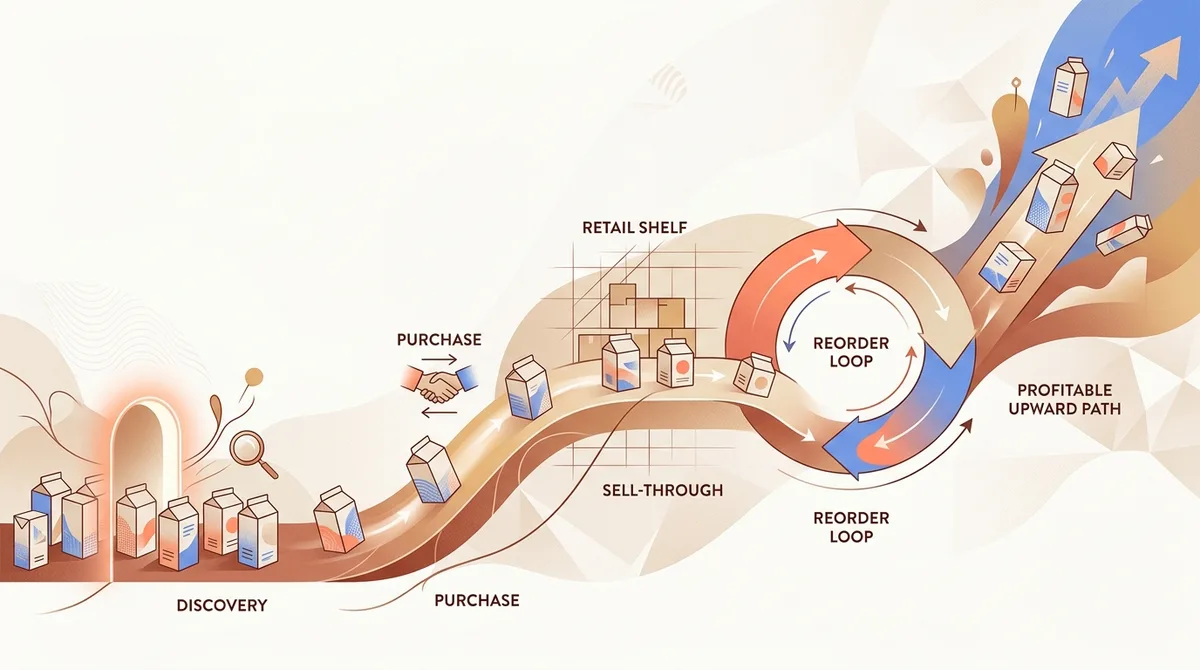
To succeed on Faire, you need more than a polished storefront. You need retailer-ready economics, relevant discovery, a page that converts, clean fulfillment, and a repeatable path from opening order to profitable reorder. If one link breaks, more traffic only makes the underlying problem more expensive.
That is why generic lists of Faire tips rarely help. A brand with no impressions has a different problem from a brand getting clicks but no orders. A brand growing revenue while losing money has a different problem again. Start with the symptom, find the constraint, then fix the right part of the system.
How to succeed on Faire starts with the right diagnosis
Faire growth has five stages. Measure them separately.
- Visibility. The right retailers see your products in search, browse, collections, campaigns, or outside links.
- Consideration. Those retailers click through and understand the product, shelf story, and economics quickly.
- Conversion. They can justify the opening order and complete it without unanswered operational questions.
- Retention. The product sells through, the account is supported, and the retailer reorders.
- Profitability. The relationship produces contribution margin after fees, discounts, advertising, fulfillment, and account labor.
Do not collapse those stages into one revenue number. Revenue can rise while new-customer acquisition gets less efficient or discounted orders fail to reorder. Your weekly view should show impressions, product views, opening orders, returning orders, average order value, contribution margin, and time to reorder.
The next action should come from the broken stage. No impressions means a relevance or demand problem. Views without orders mean a conversion problem. Opening orders without reorders mean a sell-through or account-management problem. Revenue without profit means an economics problem.
Start with Faire unit economics
Before you chase ranking, prove that the order works financially. Faire's current U.S. and Canada brand terms charge a 15% marketplace commission, plus a $10 new-customer fee on opening orders. Payment processing is 1.9% plus $0.30 for 60-day payout, 2.4% plus $0.30 for 30-day payout, or 3.5% plus $0.30 for next-day payout.
Those fees are only the visible layer. Add cost of goods, pick and pack, packaging materials, brand-funded discounts, brand-funded shipping, samples, replacements, Promoted Listings spend, and the time required to service the account. The complete Faire unit economics model shows how to calculate contribution margin on both opening orders and reorders.
Your opening-order minimum belongs inside that model. Lower minimums reduce the retailer's risk, but they also create more small shipments. The right minimum is the lowest order your target retailer can test while your brand still earns an acceptable contribution margin.
Opener analyzes your last 12 months of Faire orders and buyer conversations, then surfaces reorder patterns, dormant accounts, and SKU performance.
Book a DemoFix visibility when impressions are weak
Faire says its search system uses more than 100 signals. The exact weights are not public, and results are personalized to each retailer. The platform first matches the query to product titles, descriptions, product types, and categories. It then considers retailer activity and brand performance, including conversion, reviews, returns, cancellations, and fulfillment timing. The current Faire search and ranking guide is the source to trust when older advice conflicts with current behavior.
Start with relevance. Give each product a plain-language title that matches how a buyer searches. Put it in the most specific category. Complete every applicable attribute so it appears in filters. Use unique descriptions that state what the product is, who buys it, key specifications, case quantity, wholesale price, and suggested retail price.
Then inspect demand. If a precise, complete listing still gets no impressions, the problem may be limited buyer demand for that product, season, or category. Do not keyword-stuff your way around weak channel fit. Test new collections, seasonal language ahead of the buying window, Faire Direct traffic, and targeted outreach. The Faire SEO and storefront guide turns that audit into a weekly workflow.

Improve conversion when retailers view but do not order
A buyer landing on your shop is not reading it like a consumer. They are underwriting a shelf decision. Make these answers obvious on the first screen and product page:
- What is the product and why will a shopper notice it?
- What does the retailer earn at the suggested retail price?
- How much inventory must the retailer risk?
- How many units are in a case, and how large is each unit?
- How quickly can the order ship?
- Which products should a new account start with?
- What proof shows the product can sell through?
Use a tight bestseller collection for the opening order. Put newness and seasonal items in separate collections. Show clean pack shots, lifestyle context, and a shelf or scale reference when size is not obvious. Complete UPC, dimensions, ingredients or materials, shelf life, case quantity, and lead time.
Reviews help buyers reduce perceived risk, but earn them cleanly. Faire lets brands send a personalized review request through Messenger. The platform's review guidance also recommends thanking positive reviewers and addressing negative feedback directly. Never fabricate, coerce, or reward a review.
Buy visibility only after the storefront converts
Promoted Listings are pay-per-click ads placed in search and browse surfaces. Faire automates targeting and product selection based on relevance and estimated order likelihood. Paid traffic can accelerate a storefront that already converts. It cannot repair confusing positioning, weak retailer margin, missing information, or an assortment buyers do not want.
Run ads as a controlled test. Choose the customer audience, set a fixed budget and time window, record the organic baseline, then judge the cohort on contribution margin and downstream reorders. The Promoted Listings measurement playbook explains why platform-attributed sales and incremental profit are not the same number.
Start with new customers if acquisition is the goal. If you include returning customers, evaluate them separately. Paying for a reorder that was already likely to happen can make reported return on ad spend look strong while adding little new revenue.
Do not use Promoted Listings to diagnose a listing. If impressions increase but clicks and orders stay weak, the ad has exposed the conversion problem. Pause, fix the page and offer, then test again.
Treat Faire Market as a full campaign
Faire Market is a biannual buying event, not a four-day coupon. Buyers build shortlists early. Faire's own retailer preparation guide says retailers often confirm brands during Market after doing their research beforehand.
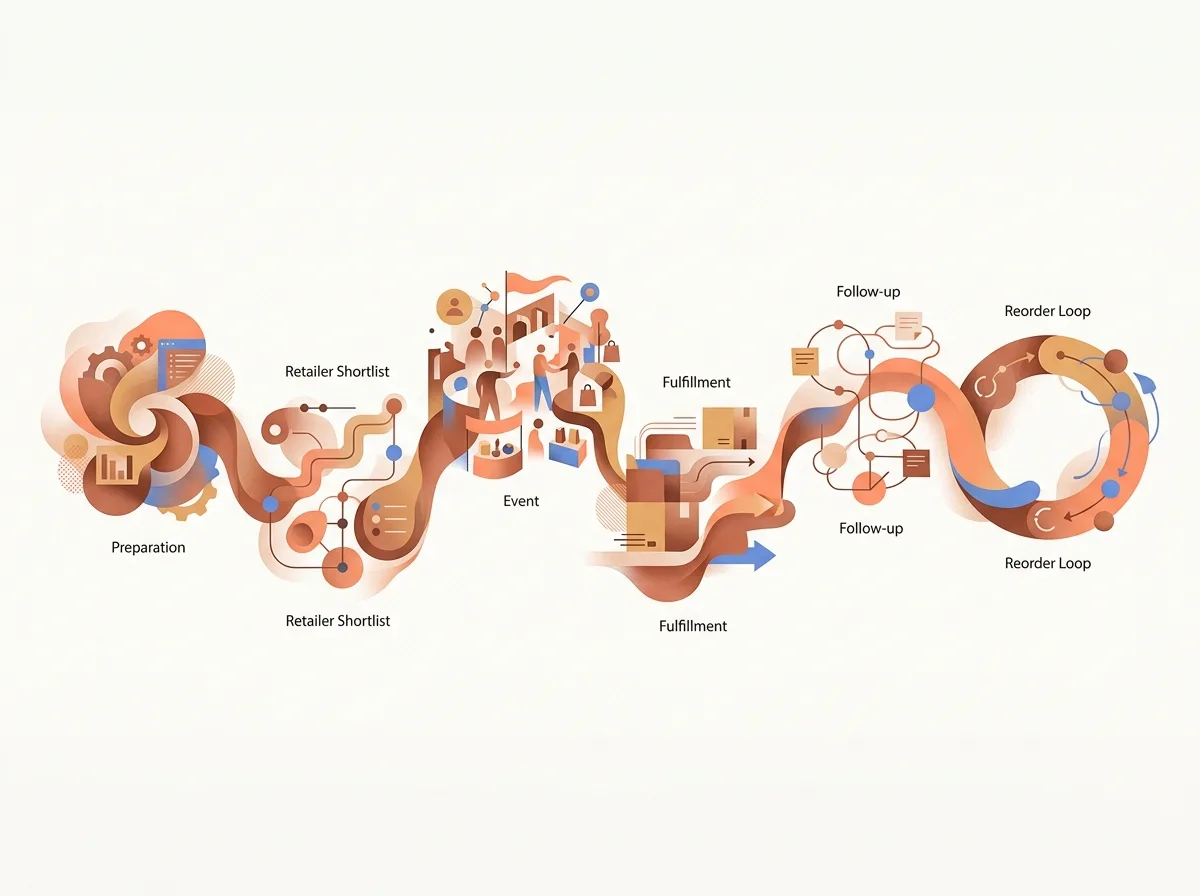
Plan the event in three phases. Before Market, refresh listings, choose the offer, segment accounts, and send previews. During Market, remind high-fit retailers, respond fast, and protect inventory. After Market, onboard every opening account and measure whether discounted orders become full-price reorders.
The Faire Market ROI playbook includes a practical timeline and a cohort scorecard. Its central rule is simple: evaluate Market over 90, 180, and 365 days, not just event-week gross merchandise value.
Turn every opening order into a sell-through plan
The first order is inventory on someone else's shelf. It becomes a valuable account only when consumers buy the product and the retailer replenishes it.
Build a 30-day account kickoff. Confirm delivery, share a compact merchandising kit, ask where the product landed, and offer one useful selling point the retailer can hand to staff. Estimate a likely stockout window from unit count and reasonable weekly velocity, then follow up before that window closes.
Segment follow-up by account state. New accounts need launch support. Active accounts need timely replenishment and newness. Slipping accounts need a specific reason to reengage. Dormant accounts need a relevant change, such as a new SKU, format, price point, or local proof. The Faire reorder system maps the cadence without turning every buyer conversation into a generic reminder.
Review account performance alongside your Faire marketplace data. Track first-to-second-order rate, median days to reorder, reorder value, active accounts, dormant accounts, and contribution margin by cohort. Those numbers tell you whether the book is compounding.
Use Faire Direct without crossing the policy line
Faire Direct can give qualified relationships 0% commission while preserving retailer payment terms and other platform benefits. Payment processing fees still apply. Qualification is specific, not automatic.
Under Faire's current Direct commission policy, a relationship can qualify when the retailer uses your Direct tools for the first order, when the retailer ordered from you before its first Faire order within the stated window, or when documented Direct-link outreach meets the stated response and timing rules. Uploading a contact alone does not create a qualifying relationship.
Do not move a retailer introduced by Faire off-platform to avoid commission. Keep relationship and outreach records, send the correct Direct link, and use Faire's formal commission-change process when a legitimate pre-existing relationship was classified incorrectly.
Run one weekly Faire operating review
The useful weekly review takes 30 minutes and ends with decisions.
- Check impressions and views by product.
- Check opening-order conversion and average order value.
- Review cancellations, missing items, response time, and late shipments.
- Flag accounts approaching their likely reorder window.
- Review dormant accounts and assign a relevant next action.
- Calculate contribution margin for new and returning cohorts.
- Choose one experiment, one owner, one stop rule, and one review date.
No algorithm folklore. No random discounting. The right next move comes from the constraint visible in your numbers.
Frequently asked questions
Why am I getting no sales on Faire
Find the broken stage. No impressions points to relevance, demand, or channel fit. Impressions without clicks point to imagery, title, price, or positioning. Views without orders point to retailer economics, minimums, assortment, proof, or missing operational details. Opening orders without reorders point to sell-through and account support.
How long does it take to succeed on Faire
There is no credible universal timeline. Category demand, catalog quality, seasonality, outside traffic, pricing, and existing retailer relationships all change the answer. Set a 90-day testing window with weekly leading indicators, then judge account quality over the following reorder cycle.
Is Faire profitable for small brands
It is profitable when the order and the relationship cover marketplace fees, payment processing, discounts, advertising, fulfillment, cost of goods, and servicing time. Model opening orders and reorders separately. A first order can be intentionally lower margin if the expected repeat behavior is supported by real cohort data.
Should I lower my opening-order minimum
Lower it only when the smaller order remains operationally sensible. The goal is not the lowest minimum on Faire. The goal is a low-risk test for the retailer that still protects your contribution margin and gives the product enough shelf presence to sell.
Build a Faire account base that compounds
Succeeding on Faire is an operating discipline. Get the economics right, earn relevant visibility, make the buyer decision easy, fulfill cleanly, and work every account toward a profitable reorder. When the funnel is measured stage by stage, you stop guessing and start fixing the constraint that actually limits growth.
Opener works your wholesale book daily, follows reorder signals, and revives accounts that have gone quiet. No retainer. No setup fee.
Book a Demo