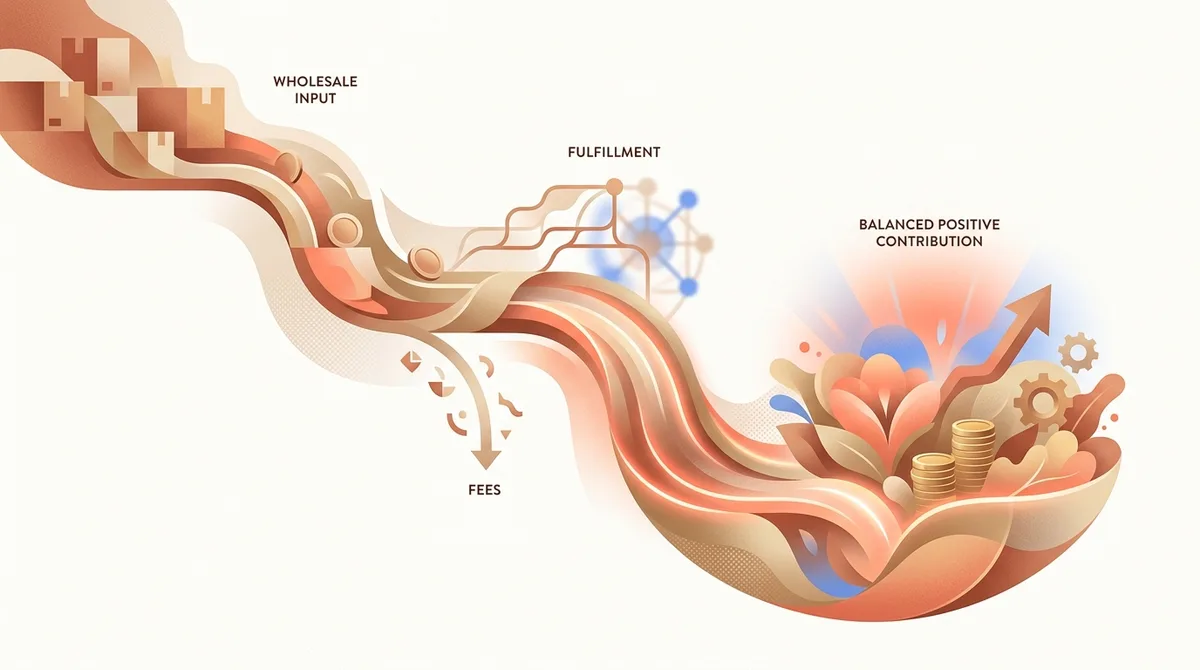
Faire profitability is not the payout shown beside an order. It is the contribution left after marketplace fees, payment processing, discounts, advertising, product cost, fulfillment, replacements, and the labor required to manage the account. Calculate that number before you lower minimums or buy more traffic.
A marketplace can produce impressive revenue and weak economics at the same time. The opening order often carries the highest acquisition cost. The reorder tells you whether the relationship can become valuable. Model them separately, then connect them through first-year account value.
What Faire charges brands
For brands in the United States and Canada, Faire's current brand terms state the following fees:
- 15% commission on marketplace opening orders, plus a $10 new-customer fee
- 15% commission on marketplace reorders
- 0% commission on qualified Faire Direct orders
- 1.9% plus $0.30 for a 60-day payout
- 2.4% plus $0.30 for a 30-day payout
- 3.5% plus $0.30 for a next-day payout
Commission and processing are calculated on the order subtotal after brand-funded discounts. Faire Direct removes commission only when the relationship meets the current qualification policy. Processing still applies.
That is the published fee layer. Your model also needs costs Faire does not know, including cost of goods, pick and pack, cartons, inserts, freight you fund, samples, advertising, damaged or missing units, and account-management time.
Treat the opening order as acquisition and the reorder as retention. If you blend them together, a high-margin reorder can hide an expensive first order, or a heavily discounted event can make an otherwise healthy account look worse than it is.
Use the complete Faire contribution formula
Start with the amount the brand actually sells after its own discount.
Discounted order subtotal = gross wholesale merchandise value minus brand-funded discounts
Then calculate the contribution from that order.
Order contribution = discounted order subtotal minus Faire commission minus new-customer fee minus payment processing minus cost of goods minus fulfillment minus brand-funded freight minus advertising allocation minus replacements minus account labor
This is contribution, not company profit. It does not include every fixed overhead expense. It gives you a clean channel-level number for comparing Faire orders, promotions, customer cohorts, and acquisition methods.
The broader Faire success playbook uses this margin as the final stage of its diagnostic funnel. Visibility and conversion matter only when the resulting account creates acceptable contribution over time.

Work through a Faire opening-order example
Assume a retailer places a $300 opening order during a 10% brand-funded promotion. The discounted order subtotal is $270.
Using the 60-day payout option:
| Line item | Amount |
|---|---|
| Gross wholesale merchandise value | $300.00 |
| Brand-funded discount | -$30.00 |
| Discounted order subtotal | $270.00 |
| 15% marketplace commission | -$40.50 |
| New-customer fee | -$10.00 |
| Processing at 1.9% plus $0.30 | -$5.43 |
| Payout before brand costs | $214.07 |
Now add the costs unique to your brand. Assume $135 in cost of goods, $14 in pick and pack, $4 in materials, and $20 of allocated acquisition spend. The order contributes $41.07 before account labor and any brand-funded freight. That is 15.2% of the discounted order subtotal.
The example is not a benchmark. Replace every assumption with your own invoice, warehouse rate card, bill of materials, and campaign data. A brand with 35% cost of goods will see a different result from one at 55%. A case that ships in its own carton behaves differently from a fragile assortment that needs hand packing.
Opener unifies Faire order and buyer-conversation history so you can see reorder patterns, dormant accounts, and SKU performance in one place.
Book a DemoModel the reorder differently
A marketplace reorder still carries 15% commission and payment processing, but it does not carry the $10 new-customer fee. It may also require less promotional spend and less onboarding labor.
Using the same $270 subtotal, product cost, and fulfillment assumptions, removing the new-customer fee and the $20 acquisition allocation raises order contribution from $41.07 to $71.07. That difference is why first-to-second-order conversion matters so much.
Do not assume every account will reorder. Use the actual reorder rate for a cohort of comparable accounts. Segment by first-order month, category, acquisition source, promotion, and order size. The Faire marketplace data guide shows how to separate new and returning stores instead of reading only topline order volume.
Calculate first-year account value
First-year account value should be contribution, not revenue.
Expected first-year contribution = opening-order contribution + expected number of first-year reorders multiplied by average reorder contribution
If an opening order contributes $41 and the cohort averages 1.4 reorders at $71 contribution each, expected first-year contribution is about $140. That gives you a ceiling for acquisition spend. If the same cohort averages 0.3 reorders, expected contribution falls to about $62.
Use observed cohort data whenever possible. A founder's hope that the retailer will reorder three times is not a forecast. For young accounts, update the model monthly as the reorder curve develops.
Track these first-year fields:
- Opening-order contribution
- First-to-second-order rate
- Median days to first reorder
- Average reorder contribution
- Reorders per account at 90, 180, and 365 days
- Cumulative contribution by acquisition source
- Dormant-account rate
The operational work behind those numbers lives in the Faire reorder and retention system.
Set a minimum that works for both sides
Order minimum advice often stops at “go lower.” That is incomplete. A lower opening minimum can improve conversion by reducing retailer risk. It can also turn the warehouse into a loss center.
Find your economic floor first. Add the fixed costs that exist regardless of order size, such as the $10 opening fee, per-order processing charge, pick fee, carton, paperwork, and account labor. Then calculate the smallest subtotal that clears your contribution target.
Next, check whether that order creates a credible shelf test. A minimum that lets a retailer buy only two scattered units may reduce the chance of sell-through. Use case packs and a focused starter assortment to create a low-risk order that still has enough presence to perform.
Do not copy another brand's $100 or $150 minimum. Their product cost, case pack, breakage, warehouse fees, and target retailer are different. Calculate your floor, then test conversion around it.
Price Faire Market promotions against retention
A Market order can include a brand-funded discount, possible brand-funded shipping, and paid promotion. That makes event-week revenue a poor measure of success.
Create a separate cohort for every Faire Market. Record the full acquisition cost per new account, then follow contribution at 90, 180, and 365 days. Compare full-price reorder behavior with accounts acquired outside the event. The Faire Market ROI model provides the campaign timeline and post-event scorecard.
Set the offer from the model backward. Decide how much first-year contribution you are willing to exchange for a new qualified account. Do not start with the largest discount the interface suggests and hope reorders cover it.
Allocate Promoted Listings to the acquired account
Advertising cost belongs to the cohort it helped create. If you spend $600 and acquire 12 genuinely new accounts, the provisional paid acquisition cost is $50 per account. If four accounts would likely have ordered without the ads, the incremental acquisition cost is higher.
Judge paid listings on new-account contribution and later reorders, not platform-attributed revenue alone. The Promoted Listings profitability guide sets a baseline, audience split, stop rules, and payback test.
Keep returning-customer ads separate. Paying for a likely reorder is a retention expense, not new-customer acquisition. It can still make sense, but it needs its own objective and comparison group.
Include labor or the model will lie
Small Faire orders can create a surprising amount of work. Someone accepts the order, resolves changes, prepares warehouse instructions, answers messages, handles claims, requests reviews, and follows up for reorders.
Track that time for four weeks. Multiply hours by a realistic loaded hourly cost, even if the founder does the work. Allocate the result by account or order. Founder time is not free because it replaces other revenue-producing work.
Automation should reduce repetitive analysis and follow-up, but keep one clear owner for the retailer relationship. No duplicate messages. No conflicting offers. One account, one history, one next step.
Separate fixed channel work from variable account work. Storefront maintenance, reporting, and campaign planning belong in a monthly channel budget. Order changes, claims, and reorder follow-up belong to the account or cohort that caused them. That split shows whether growth is absorbing existing capacity or creating enough service work to require another hire.
Review Faire profitability every month
Use one monthly scorecard:
- Contribution margin by opening order and reorder
- Contribution by source, including organic, Direct, Market, and paid listings
- First-to-second-order rate by cohort
- Median reorder timing and contribution payback period
- Loss-making order count and the reason for each loss
- Dormant-account contribution available to recover
- Founder and team hours spent on the channel
The decisions should be concrete. Raise or restructure a minimum. Remove a fragile low-margin SKU from paid promotion. Change the payout speed. Narrow the Market offer. Stop an ad cohort. Give high-potential accounts better post-order support.
Scale contribution, not Faire revenue
Faire profitability improves when opening-order risk is controlled and high-quality accounts reorder. Build the full cost stack, separate acquisition from retention, and evaluate every promotion or ad against first-year contribution. The number worth scaling is not marketplace revenue. It is profitable account value.
Opener gives every wholesale account its own AI rep, working the book daily and reviving accounts that have gone quiet.
Book a Demo